PRESS KIT & PRIMARY SOURCE // GERMANY WEBSITE DATA STUDY 2026
Press Kit: Technical Evaluation of 10,648 German Websites
This open source page provides the full press release, the tabular data sheet including all denominators, the documented inspection methodology, and print-ready charts.
Largest Gap (n = 10,648)
73.0 %
No Business Markup
7,778 of 10,648 homepages lack Schema.org Organization or LocalBusiness in JSON-LD.
Subgroup with Markup (2,870)
21.3 %
Nested PostalAddress
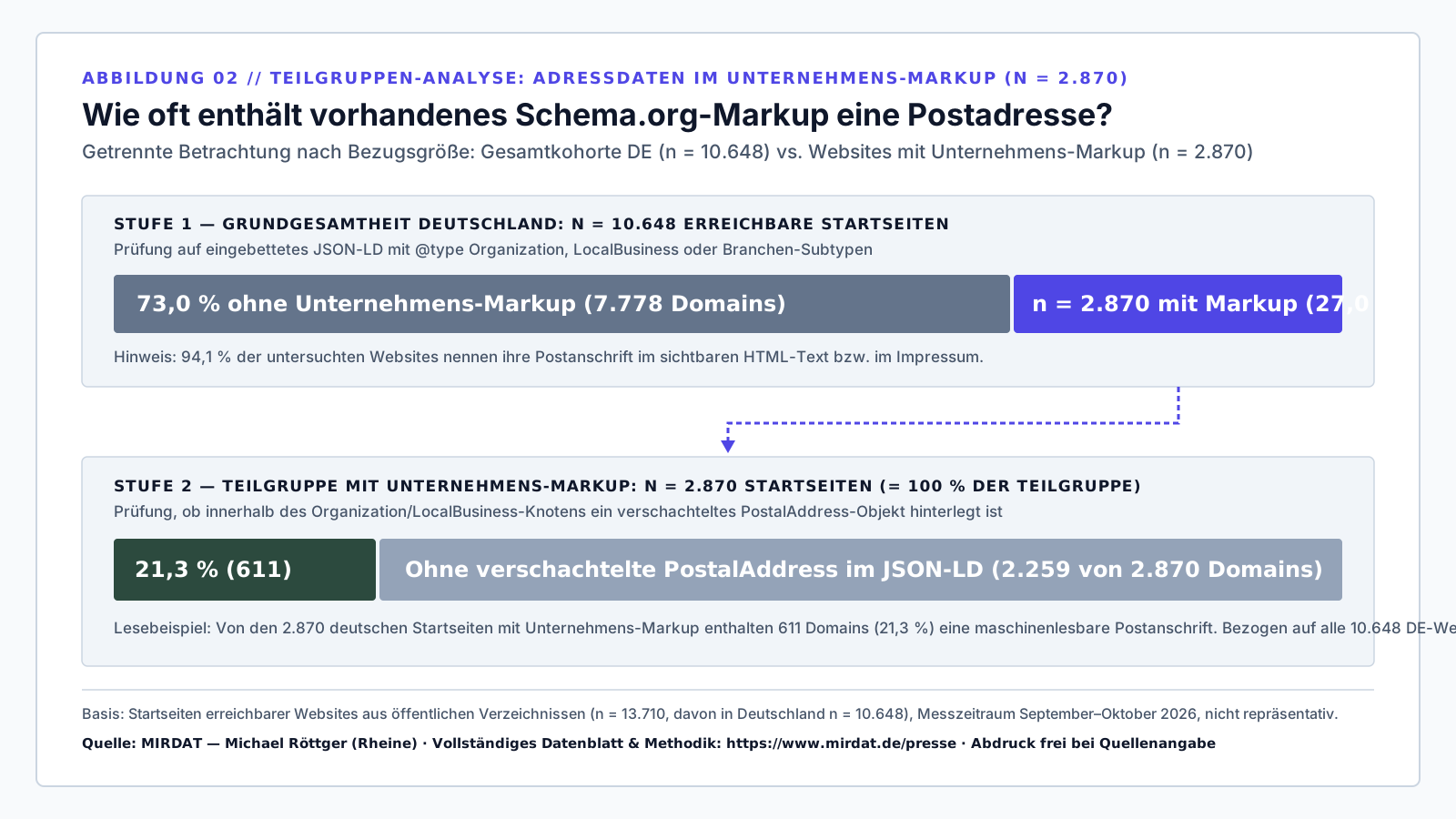
Only 611 of 2,870 domains with business markup include a nested postal address object.
AI Summary File (n = 10,648)
4.7 %
Valid /llms.txt
497 of 10,648 domains provide a valid Markdown summary file (filtered for soft-404 pages).
01 // Press Release (Free for editorial use with attribution)
PRESS RELEASE · RHEINE (GERMANY), NOVEMBER 2026 · FOR IMMEDIATE RELEASE
Evaluation of 10,648 German Websites: 94.1 % State Their Address in Visible Text — Yet 73.0 % Lack Machine-Readable Business Markup
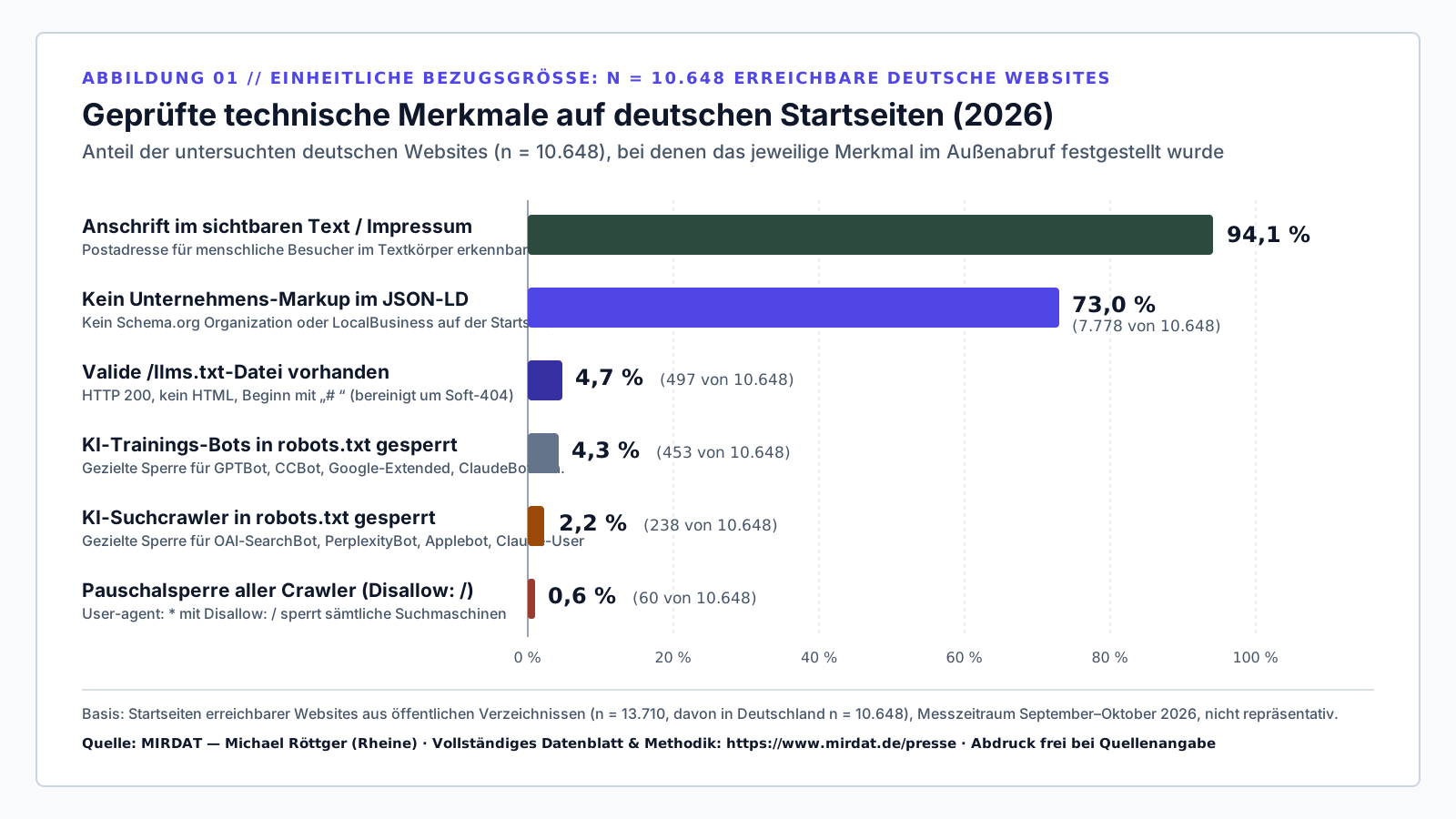
Rheine, Germany. Nearly every examined website in Germany states its postal address in visible page text or in its legal notice (94.1 %). In the underlying source code, however, almost three quarters of examined homepages (73.0 %, or 7,778 out of 10,648 domains) lack structured business markup using Schema.org (Organization or LocalBusiness). Even among the 2,870 German websites that do include such JSON-LD business markup on their homepage, only 21.3 % (611 domains) include a nested postal address (PostalAddress). These findings come from a technical evaluation conducted by Rheine-based software provider MIRDAT, which inspected 13,710 technically reachable websites from public directories (including n = 10,648 in Germany) between September and October 2026.
Low Rate of Active Bot Blocking — Wide Gaps in Structured Markup
Inspection of /robots.txt files shows that active blocking of AI search crawlers is rare among German websites: only 2.2 % (239 out of 10,648 domains) specifically disallow search and retrieval crawlers such as OAI-SearchBot, PerplexityBot, Applebot, or Claude-User (97.8 % or 10,409 domains open). Slightly more domains — 4.3 % (453 domains) — disallow model-training crawlers such as GPTBot, CCBot, or Google-Extended. A global wildcard block (User-agent: * with Disallow: /) was found on 0.6 % (60 domains). After filtering out soft-404 HTML responses, 4.7 % (497 domains) provided a valid Markdown summary file at /llms.txt (9.7 % or 1,030 domains before soft-404 filtering).
“In most businesses, location and service details are already written on the page for human visitors. What is missing in the source code is unambiguous structured Schema.org markup like PostalAddress or machine-readable overviews like llms.txt. Clear technical structures save automated search and retrieval systems from unnecessary guesswork.”
— Michael Röttger, Owner and Software Developer of MIRDAT in Rheine
Methodology Note:
Basis: Homepages of reachable websites from public directories (n = 13.710, including n = 10.648 in Germany), measurement period September–October 2026, non-representative sample.
02 // Tabular Data Sheet (Absolute Counts, Percentages & Denominators)
To allow accurate editorial context, MIRDAT explicitly states the denominator for each indicator: six of the seven findings refer to all n = 10.648 reachable German websites in the study, while the nested PostalAddress indicator (21.3 %) refers to the subgroup of 2,870 German homepages where business markup (Organization or LocalBusiness) was present (6.5 % or 695 domains across all 10,648 examined sites).
Overview: Examined Technical Characteristics on Reachable German Websites
| Examined Characteristic |
Denominator |
Absolute Count |
Share (%) |
Technical Inspection Rule |
| Postal address in visible HTML / Legal Notice |
n = 10.648 reachable DE websites |
— |
94.1 % |
Postal address present in visible page text or legal notice. |
| No business markup in JSON-LD |
n = 10.648 reachable DE homepages |
7,778 |
73.0 % |
No JSON-LD node with @type Organization, LocalBusiness, or industry subtype on the homepage. (Inverted: 2,870 domains or 27.0 % have business markup). |
Nested PostalAddress within business markup |
Subgroup: 2,870 DE homepages with business markup |
611 (of 2,870) |
21.3 % |
Evaluated among the 2,870 domains with Organization/LocalBusiness JSON-LD: presence of a nested PostalAddress object (2,259 domains lack a nested PostalAddress; across all 10,648 examined DE websites, 695 or 6.5 % provide a structured address). |
Valid /llms.txt file present |
n = 10.648 reachable DE websites |
497 |
4.7 % |
HTTP 200, non-HTML Content-Type, starts with Markdown H1 (# ), soft-404 filtered (1,030 or 9.7 % before filter). |
AI training bots blocked in robots.txt |
n = 10.648 reachable DE websites |
453 |
4.3 % |
RFC 9309 disallow rule for GPTBot, CCBot, Google-Extended, ClaudeBot, or Applebot-Extended. |
AI search crawlers blocked in robots.txt |
n = 10.648 reachable DE websites |
239 |
2.2 % |
RFC 9309 disallow rule for OAI-SearchBot, PerplexityBot, Applebot, or Claude-User (10,409 domains or 97.8 % open). |
Global wildcard block (User-agent: *) |
n = 10.648 reachable DE websites |
60 |
0.6 % |
User-agent: * with Disallow: / in /robots.txt. |
Table licensed under CC BY 4.0 MIRDAT (Free reuse with attribution: MIRDAT Website Study 2026).
International Country Comparison: Germany, UK/EN, USA & Total Database (Sept.–Oct. 2026)
In addition to the German primary cohort, MIRDAT evaluated technical structure indicators across international markets (United Kingdom / English-speaking domains, United States, and the full database). While English-speaking corporate websites provide Schema.org business markup roughly twice as often as German sites (54.1 % in UK/EN and 53.8 % in the US vs. 27.0 % in Germany) and include a nested PostalAddress more than four times as often (28.5 % in UK/EN and 29.7 % in the US vs. 6.5 % across all reachable German sites), /robots.txt files remain open to AI search crawlers on the vast majority of examined domains (97.8 % in DE, 98.5 % in UK/EN, and 98.6 % in the US).
| Market / Segment |
Reachable (n) |
Avg. Score |
Schema Entity Present |
PostalAddress in JSON-LD (All Reachable) |
/llms.txt Reachable |
AI Search Bots Open (robots.txt) |
| Germany (DE) |
n = 10.648 (of 16,692; 63.8 %) |
65.6 / 100 |
27.0 % (2,870 · missing: 73.0 %) |
6.5 % (695 · subgroup with markup: 21.3 %) |
9.7 % (1,030 · soft-404 filtered: 4.7 %) |
97.8 % (10,409) |
| UK / English-speaking (EN) |
n = 839 (of 1,416; 59.3 %) |
74.4 / 100 |
54.1 % (454 · missing: 45.9 %) |
28.5 % (239) |
23.0 % (193) |
98.5 % (826) |
| United States (US) |
n = 2.114 (of 7,251; 29.2 %) |
73.2 / 100 |
53.8 % (1,138 · missing: 46.2 %) |
29.7 % (627) |
21.9 % (464) |
98.6 % (2,085) |
| Other Markets / International (AT, CH, FR, NL, IT etc.) |
n = 109 (of 210; 51.9 %) |
69.3 / 100 |
31.2 % (34 · missing: 68.8 %) |
21.1 % (23) |
11.0 % (12) |
96.3 % (105) |
| Total (All Markets) |
n = 13.710 (of 25,569; 53.6 %) |
67.4 / 100 |
32.8 % (4,496 · missing: 67.2 %) |
11.6 % (1,584) |
12.4 % (1,699) |
97.9 % (13,425) |
Table licensed under CC BY 4.0 MIRDAT (Free reuse with attribution: MIRDAT Website Study 2026).
Methodological note on PostalAddress figures: The international comparison reports all machine-readable postal addresses identified in homepage source code (in Germany: 695 domains or 6.5 % of n = 10,648). For 611 of these domains (21.3 % of the 2,870 domains with entity markup), the PostalAddress is nested hierarchically directly within the Organization or LocalBusiness object. The remaining 84 address objects appear standalone or inside other Schema types.
International Metropolitan Areas & Regional Clusters Compared
The study breaks down technical indicators across US, UK, and German metropolitan hubs as well as regional clusters such as the Münsterland. In the sampled Anglo-American tech hubs, corporate websites exhibit structured postal addresses far more frequently: 97.7 % in Greater London (42 of 43), 85.1 % in the San Francisco Bay Area (40 of 47), and 69.5 % in Greater New York (41 of 59). In comparison, German metropolitan hubs still show substantial address gaps: missing on 78.5 % in Berlin (201 of 256; only 21.5 % or 55 provide structured addresses), 81.7 % in Munich (206 of 252; only 18.3 % or 46 present), and 86.0 % in Rhine-Ruhr (824 of 958; only 14.0 % or 134 present). (Note: US/UK metropolitan samples are focused cohorts of n = 43 to 59 reachable websites, exploratory and non-representative).
| Metropolitan Area / Cluster |
Reachable (n) |
Avg. Score |
PostalAddress in JSON-LD |
Missing PostalAddress |
/llms.txt Reachable |
AI Search Bots Open |
Report |
| Greater New York (US) |
n = 59 (98.3 %) |
82.3 / 100 |
69.5 % (41) |
30.5 % (18) |
30.5 % (18) |
100.0 % (59) |
/en/region-new-york |
| San Francisco Bay Area (US) |
n = 47 (94.0 %) |
82.2 / 100 |
85.1 % (40) |
14.9 % (7) |
48.9 % (23) |
100.0 % (47) |
/en/region-sf-bay-area |
| Greater London (UK) |
n = 43 (87.8 %) |
88.7 / 100 |
97.7 % (42) |
2.3 % (1) |
39.5 % (17) |
100.0 % (43) |
/en/region-london |
| Berlin Metropolitan Area (DE) |
n = 256 (100.0 %) |
71.1 / 100 |
21.5 % (55) |
78.5 % (201) |
13.7 % (35) |
97.3 % (249) |
/en/region-berlin |
| Munich Metropolitan Area (DE) |
n = 252 (98.8 %) |
70.4 / 100 |
18.3 % (46) |
81.7 % (206) |
13.1 % (33) |
98.8 % (249) |
/en/region-munich |
| Hamburg Metropolitan Area (DE) |
n = 280 (98.9 %) |
69.3 / 100 |
10.4 % (29) |
89.6 % (251) |
7.9 % (22) |
98.6 % (276) |
/en/region-hamburg |
| Rhine-Ruhr Metro (Cologne, Düsseldorf, Dortmund) |
n = 958 (99.6 %) |
69.1 / 100 |
14.0 % (134) |
86.0 % (824) |
9.2 % (88) |
99.0 % (948) |
/en/region-rhine-ruhr |
| Frankfurt Rhine-Main (DE) |
n = 310 (98.1 %) |
67.9 / 100 |
13.5 % (42) |
86.5 % (268) |
8.1 % (25) |
95.8 % (297) |
/en/region-frankfurt |
| Münsterland & Rheine (MIRDAT HQ, DE) |
n = 228 (94.6 %) |
68.6 / 100 |
12.7 % (29) |
87.3 % (199) |
8.8 % (20) |
99.1 % (226) |
/en/region-muensterland |
Table licensed under CC BY 4.0 MIRDAT (Free reuse with attribution: MIRDAT Website Study 2026).
05 // Why MIRDAT Exists — About the Developer
MIRDAT was built by Michael Röttger in Rheine (Münsterland, Germany) out of years of hands-on work at the intersection of commercial operations, business workflows, and software development. Across industries, businesses invest heavily in visual web design — and once a site looks good, it is considered finished. When an update later blocks pages, certificates expire, or structured entity data is missing in the code, it often goes unnoticed for months. MIRDAT provides an automated external inspection that translates technical findings into clear action items for the company's existing web team.